The Mind of Michelangelo Merisi da Caravaggio Recaptured
Artists are often viewed as individuals who are creative, emotional, and inspirational. Whether the holder of these traits expresses them through carving into marble, laying oil onto a canvas, or allowing the keys of a piano to sing their heart’s melody, the artist’s insertion of self into their masterpieces can give viewers a glimpse into the life and mind of the creator. Sometimes, this view can be obstructed by fanciful figures and indirect allusions. In the case of that artistic “maverick” Michelangelo Merisi da Caravaggio, no such distractions exist when it comes to the insertion of his self into his paintings. The wonders of the brush that invoke such spirituality can in the same composition reflect the mind of a possible psychopath. By analyzing the psychopathic mind and juxtaposing it against the images of self-portraiture by Caravaggio, it can very well be concluded that the artist did suffer from psychopathic disorder.
Psychopathy Defined
Psychopathy is a mental disorder popularized by commentators on criminal behavior. The term “psychopath” is often misused and is made synonymous with psychotic, insane, violent, and threatening behaviors. This view of the disorder should be disregarded, as it is incorrect. A Hannibal Lecter-like character should not come to mind, but rather an individual that one may deem friendly, a little mischievous, but still trustworthy. Psychopathy, to be understood properly, should be viewed as disorders like Post-Traumatic Stress Disorder or depression. Geoff Hamilton’s “Mythos and Mental Illness: Psychopathy, Fantasy, and Contemporary Moral Life” uses the definition given by Dr. Hugues Hervé, which is, “instrumentally impulsive individuals with poor behavioral controls who callously and remorselessly bleed others for purely selfish reasons via manipulation, intimidation, and violence.” This definition seems to further the previously established opinion of psychopaths by recognizing that criminality does not always exist alongside the traits. Criminal behaviors are present secondarily to emotional traits of psychopathy as researched by Beatriz Pérez, Juan Herrero, Judith Velasco, and Francisco Javier Rodriguez-Díaz in “A Contrastive Analysis of the Factorial Structure of the PCL-R: Which Model Fits Best the Data?”
How, then, will it be proven that Caravaggio fits the definition of a psychopath? Now is a better moment than any to establish the obvious fact that a true analysis of a psychopath cannot be done unless the individual is interviewed. This statement, with its great integrity, should be taken into consideration because it is true. For this argument, images that will be presented act as the patient’s interview, the patient being Caravaggio. Accounts of the artist’s life such as biographies, which are significant in forming what is known of the artist presently, will also be considered. These biographical accounts will provide greater insight into who the artist was outside of what he thought of himself. The textual information found on Caravaggio will also serve to better organize data chronologically to help make better sense of observations made from viewing the paintings.
To best create an interview, an analysis of Caravaggio’s paintings, specifically those in which the artist has inserted himself, will act as the testimony. Therefore, an opposing argument, which uses images by Caravaggio, even along with official accounts of the artist’s life, would be fit to oppose the argument being formed.
Hare Psychopathy Checklist—Revised, Applied
The process by which the analysis will be conducted will remain the same. That process is called the Hare Psychopathy Checklist—Revised (PCL-R), as set out by Graham Gooch and Michael Williams in Hare Psychopathy Checklist—Revised. Patients are interviewed and the following traits are rated on a scale from 0-2: superficial charm, grandiose estimation of self, need for stimulation, pathological lying, cunning and manipulative, lack of remorse or guilt, shallow affect (superficial emotional responsiveness), callousness and lack of empathy, parasitic lifestyle, poor behavioral controls, sexual promiscuity, early behavior problems, lack of realistic long-term goals, impulsivity, irresponsibility, failure to accept responsibility for own actions, many short-term marital relationships, juvenile delinquency, revocation of conditional release, criminal versatility. A normal individual may score a number closer to five on Hare’s PCL-R while psychopaths are diagnosable anywhere above 30.
First, to best utilize Hare’s PCL-R for Caravaggio, a method like the categorization of traits used in a study by Beatriz Pérez, Juan Herrero, Judith Velasco, and Francisco Javier Rodriguez-Díaz will be applied, drawing on the traits they group under Factor 2 (Criminal Behavioral Traits). These traits will be used to focus on the life of Caravaggio in relation to psychopathic behavior, and not on the paintings. These traits are: parasitic lifestyle, poor behavioral controls, promiscuous sexual behavior, early behavior problems, lack of realistic goals, being impulsive, irresponsibility, failure to accept responsibility for own actions, many short marital relationships, juvenile delinquency, revocation of conditional release, and criminal versatility. To provide evidence of emotional behavioral problems, traits categorized in Factor 1 will also be considered; however, some will also be used to understand Caravaggio mentally by applying them to his paintings.
Evidence in Data
To help organize the argument, the following materials have been gathered: a chart of behaviors (criminal and emotional), traits displayed through the behaviors (Figure 1); a timeline of when key behaviors occurred (Figure 2); and lastly a graph which shows the level of psychopathy during certain periods in Caravaggio’s life (Figure 3).
The Chart of Behaviors (Figure 1) lists accounts in Caravaggio’s life that would have contributed to points being added to his evaluation. The list is categorized by traits that both support and oppose the argument that Caravaggio suffered from psychopathic disorder. Beside each sub-list of traits are the total number of points on Hare’s PCL-R gained. Trait points are only added to the sum of points the first time they appear in a sub-list as points are gained not from instances of characteristics being displayed, but from whether the trait is displayed at all. From this chart alone, Caravaggio would be evaluated with a total score of 32 points. At this level on Hare’s scale using this brief evaluation alone, Caravaggio would be diagnosed as a psychopath. Being only eight points away from a maximum score based on the little evidence available, Caravaggio, had he been able to undergo a true psychological evaluation, would have likely scored close to, or possibly higher than, the level of psychopathy presented in this chart.
In the timeline (Figure 2), a list composed of a few known events about Caravaggio obtained from Caravaggio: A Life by Helen Langdon, and Caravaggio by Sybille Ebert-Schifferer, and list of paintings being taken into consideration are presented. The purpose of this timeline is to supplement the Graph of Caravaggio’s Psychopathy (Figure 3). The timeline gives an explanation of noticeable changes over the course of Caravaggio’s life. In the Graph of Caravaggio’s Psychopathy, the points gained from behavior in each year are plotted on Hare’s own scale, and the number gained over each year is added to the previous until the end of the artist’s life. This is because evidence is gained from the character of the artist and characteristics are not lost. From this information, it is concluded that the score standing at any given moment, averaged across the twenty-seven years the timeline covers, is 8.2 points. This means that at any moment, Caravaggio would have been displaying at least four characteristics of a psychopath. The graph closes at 32 of a possible 40, crossing the diagnostic minimum of 30 in the final years of his life. That it arrives at the same total as the chart of behaviors, by an entirely different route, is the most compelling data that Caravaggio was indeed a psychopath. This evidence is especially compelling given that there cannot be any negations of the data with positive characteristics and can only be further proved with the addition of more knowledge that may also suggest psychopathy.
Also, looking at the Graph of Caravaggio’s Psychopathy, one can see that the trends displayed in emotional behavior and physical behaviors align almost perfectly. One can essentially see what was going on with Caravaggio’s emotional and mental state based on his physical behavior and portrayals in his self-portraits.
Criminal Behavioral Traits
To support the argument that Caravaggio was indeed a psychopath, it would be difficult to do so based on only four of twenty traits on the PCL-R. In Andrew Butterfield’s article “Brushes with Death,” the author outlines Caravaggio’s parasitic lifestyle and irresponsibility, beginning from the time he left the studio of Cavaliere d’Arpino, to when he went on to live with Cardinal Francesco Maria del Monte, to staying in the homes of friends. Homelessness is not uncommon; however, for a man who made a living painting for society’s most sophisticated, this amount of carelessness and lack of independence does not come from a man who has fallen on hard times, but rather a man who does not see anything wrong with living off the means of others. With his commissions, popularity, and connections to individuals of higher status, a greater amount of self-reliance could have been achievable, unless of course, the artist did not wish to do so or gave it no thought at all.
Looking at the life of the artist, the artist is constantly involved in criminal activity. Some instances are supported by legal documents. However, just so that one does not assume that these actions were completely based on a personality developed under normal circumstances, it is important to, in the manner of a psychiatrist, look for triggers in the past of the patient’s life. In “Learning to ‘Talk the Talk’: The Relationship of Psychopathic Traits to Deficits in Empathy Across Childhood,” Mark R. Dadds, David J. Hawes, Aaron D.J. Frost, Shane Vassallo, Paul Bunn, Kirsten Hunter, and Sabine Merz found evidence from which to infer that male psychopaths usually show a disconnect between cognitive and affective empathy during the pubertal years. By the time he was 19 years old, Caravaggio had experienced the death of his father and grandfather, his mother was suicidal, and he was orphaned. Events happening at such a pivotal period in the artist’s psychological development possibly increased his likelihood of being a psychopath. However, even if it is argued that the events themselves would not have an influence on Caravaggio displaying psychopathic traits later in life, then it must simply be ingrained in Caravaggio’s behavioral character to have someone describe him the way Mancini does as pointed out in Helen Langdon’s book Caravaggio.
Mancini says that a younger Caravaggio was “hot natured,” “would do outrageous things,” and was “an expert swordsman.” Later, Caravaggio’s violent acts included assault with rocks and swords, and an incident in which a gun was used. The act of repeatedly committing crimes, either without fear of punishment or with no regard for having faced consequences previously, displays characteristics found in Hare’s PCL-R. These acts of violence show a consistency sufficient to suggest that Caravaggio was not just a rambunctious youth who was a delinquent, but these were the criminal acts of a psychopath who could not seem to resist actions because there was nothing, mentally or emotionally, stopping him from doing so.
Introduction of Images
Finally, delving into the interview with Caravaggio by questioning, reading, and understanding the possible emotions that continue to stain his canvases with his secrets, it will be discovered that the artist’s most moving paintings hold even more thought-provoking messages, the messages of a psychopath. Some of Caravaggio’s most notable paintings are those that are of the martyrdom of saints. These paintings also happen to include portraits of the artist. If one were to think of this placement as a coincidence, it would mean the artist is subconsciously linking himself to these saints or, at the very least, their deaths. Evaluating these two aspects as intentional, which they are more likely to be, one can begin to form the image of a psychopath. Another of the images that will be explored is one based on a miracle, specifically, Christ raising Lazarus from the dead. There is also the image of Christ being arrested in which the artist appears. Lastly, there is a possible double self-portrait, where the artist depicts a young David holding the head of the giant, Goliath.
Images
The images that will be considered are Caravaggio’s The Martyrdom of Saint Matthew, Taking of Christ, Beheading of Saint John the Baptist, Burial of Saint Lucy, Raising of Lazarus, David with the Head of Goliath, and Martyrdom of Saint Ursula. The images will be presented chronologically so that a sense of progression, whether spiritual or psychological, can be better observed as well. To avoid repetitive characteristics, only the more distinct messages in the paintings will be explored in their individual analyses and the general matter will be taken into consideration.
Martyrdom of St. Matthew
Looking at Caravaggio’s Martyrdom of Saint Matthew (Figure 4), one views a composition that displays chaos at its edges, and in its center, despair. Saint Matthew, depicted as an aged man, cowers under a menacing fellow armed with a sword and an expression of rage. All other figures, with the exception of a heavenly being, are leaning towards the edges of the composition, framing the slaughter of the dear apostle. Every figure is completely immersed in the action; that is all except one. Off to the far left, a man is observed striding out of the scene. This man is Caravaggio. What does it mean to be placed in such a position as the artist has done? First, there is his expression that acknowledges what is happening. Then there is his outstretched left hand.
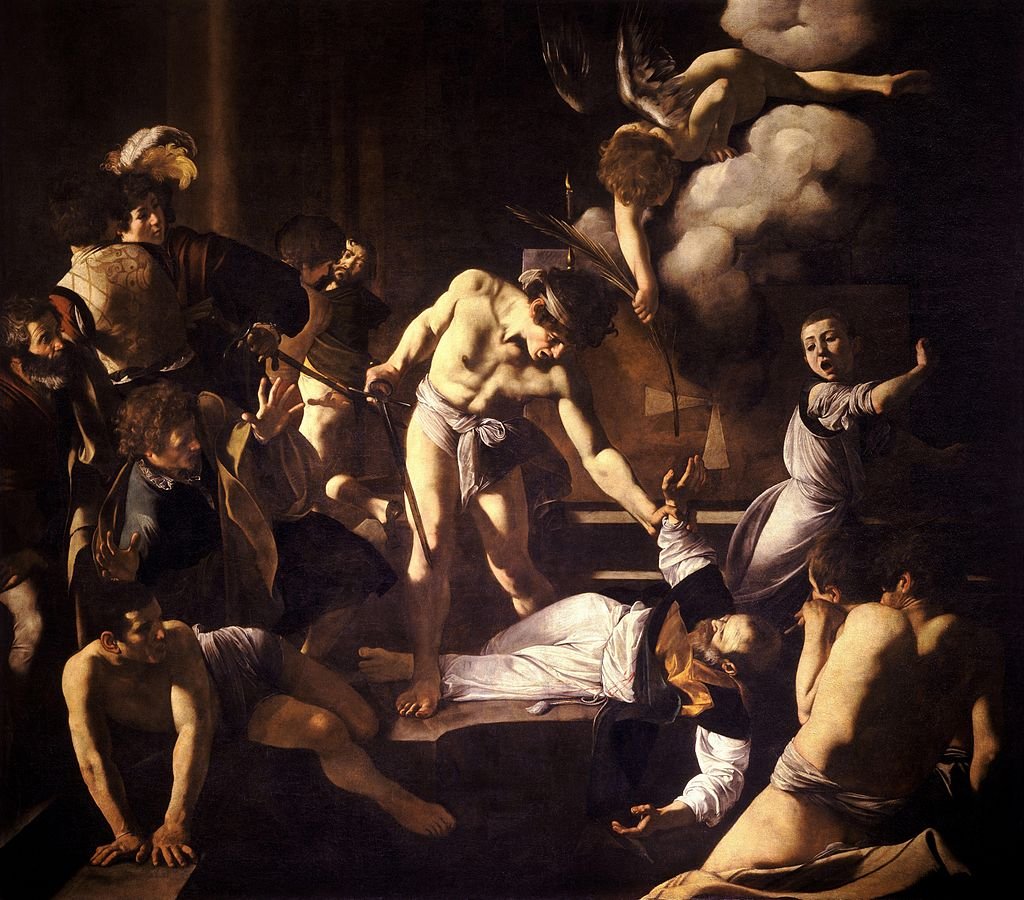
This gesture could be viewed as a display of sympathy; however, this may not be a true display of sympathy since his foot below is still in the cadence of giving no second thought to leaving the saint behind. Caravaggio has realistically depicted, in the same composition, characters fleeing and characters lounging during this martyrdom. By inserting himself into this painting, he has quite possibly shown a veneer where he “feels sorry” for the saint while maintaining the truth that he would flee. Upon the insertion of oneself into an image such as this, it would not be difficult to realize what actions would be displayed. Some would fall to the ground weeping. Others may throw up their arms in panic. One who does not suffer from some emotional or mental disarray would not be caught between emotions.
Looking back at the outstretched left hand, which presents the great confusion in Caravaggio’s body language, the motion could be a message from the artist who is known for his attention to details, especially with symbolism. The awkward positioning of the body could have been rendered to display that hand and hide the other. Taking a look into the book written by the saint for whom the painting is named, there is a passage in the sixth chapter that states, “…let not thy left hand know what thy right hand doth.” Caravaggio could be translating his thoughts to the patron and viewers of the painting that he will present himself as one who mourns with them but in actuality, he is not showing his true feelings or the lack thereof.
Taking of Christ
As mentioned before, a psychopath does not have to be a threat or display violent behavior. There are other traits found on the PCL-R like a grandiose sense of self-worth, which could score just as much as criminal versatility. Caravaggio has displayed this grandiose sense of self-worth ambitiously and beautifully in Taking of Christ (Figure 5). The composition captures the scene of Christ’s arrest found in the book of John, chapter 18, where Caravaggio shows Christ having just finished praying. On the right of Jesus is Judas committing his great betrayal as well as the soldiers who have come to arrest Christ. Also, accompanying the soldiers is Caravaggio.
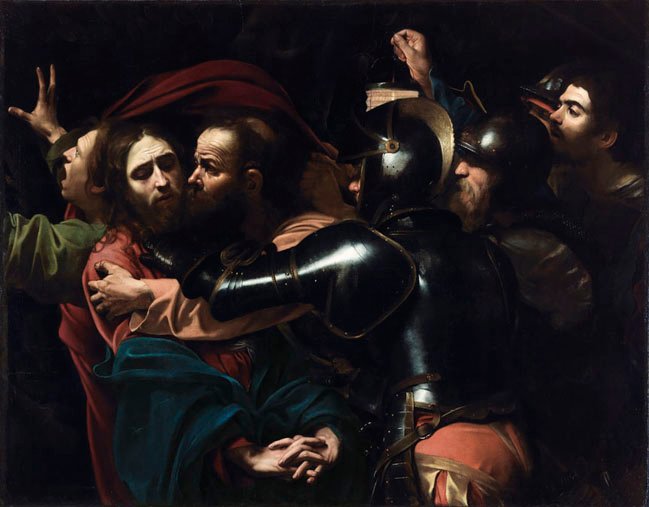
Caravaggio’s self-worth can be clearly evaluated in this image. Upon closer observation, one notices that there are not two but three sources of light to be considered in the image. The first source being the light coming from the left which illuminates most of the composition, the second being the figurative Light that is Christ, and lastly the lantern that Caravaggio holds in his hand. The artist displays himself holding up a lantern to Christ. There is already enough light coming from the left to see Christ; therefore, this could be light that references knowledge. The artist proclaims that in his painting, he brings light to the knowledge of Christ. That simple statement may not immediately imply that Caravaggio has a great sense of self-worth, but that the artist, in his painting, looks beyond Christ when shining his light and not at Christ. Again, everyone in the composition is immersed in the action taking place, except for Caravaggio who is more interested in what is going on outside of the composition. It seems that even Jesus Christ could not get Caravaggio’s attention and the artist has no issue with displaying that fact.
Beheading of Saint John the Baptist
Caravaggio, as an instrument in the name of the Catholic Church for inciting devotion or paying homage to saints, seemed to take his job to the next level as if to ensure that no man, woman, or child could escape with their spirit unmoved. Other painters of the time painted images as violent as Caravaggio’s; however, because of the realism and unfiltered view of even the most disturbing of images, Caravaggio stands out. Again, not taking into account his criminal background, in his painting Beheading of Saint John the Baptist (Figure 6), Caravaggio does something that is not natural. Already, the scene is a horrific one as the beloved saint, an innocent man, is being killed as the reward for a favor from a daughter to her father. If Caravaggio had depicted himself as a prisoner staring off into some mysterious light source, that would have been more appropriate than what he has done instead. As explained in David M. Stone’s “Signature Killer,” this painting was created for the Knights of Malta who took Caravaggio in after he committed murder, and in it the artist wrote his name in the blood of the saint.
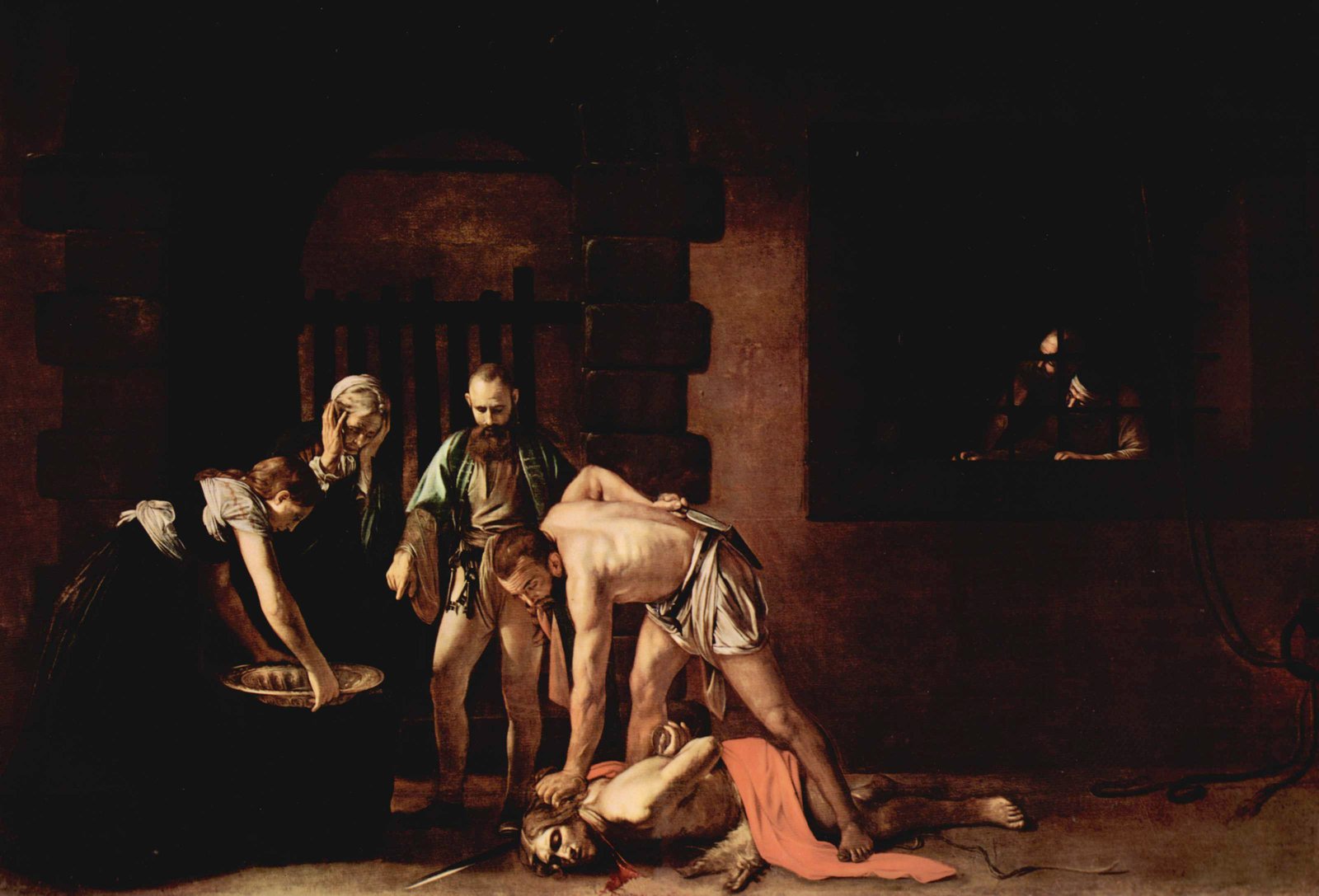
Even if the signature is an establishment of brotherhood, ownership, or a form of self-portraiture, it speaks more about the artist in reality than if he had inserted himself figuratively. Christian or not, an observer of the image would feel disturbed when looking at such a realistic man being slain by having his head severed from his body. That is of course, if the viewer has the capacity to empathize or, in Caravaggio’s case, to empathize or feel any guilt for previous actions.
At this point in the chronology of the paintings, Caravaggio’s psychopathy seems to have developed. He now blatantly places himself in the gruesome images as well. There is no more hiding his lack of emotion as if not to ruin his reputation as a good painter. He may freely hide behind his outstanding talent should his disregard of emotions come into question.
Burial of Saint Lucy
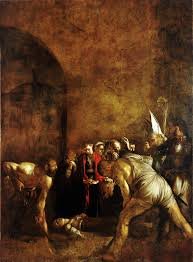
Caravaggio’s cameo appearances are never friendly. It is in Burial of Saint Lucy (Figure 7), where viewers might ask why he inserted himself at all. Saint Lucy’s martyrdom was one vile act after another. It is, however, the moment of burial that Caravaggio has painted. The context of the composition is in the lower half of the canvas where one can see two men digging, a priest, and others gathered to mourn the loss of Saint Lucy. Then, just behind the hand of the priest is Caravaggio. As this painting was created after the Beheading of Saint John, Caravaggio’s mental state seems to become more obvious. He displays the trait of being shallow by inserting himself just so that his embodiment in the painting can pay no attention or respect to Saint Lucy. Caravaggio’s insertion here seems to show no true purpose other than to have his likeness captured in the moment. Still he stares off into a light from another source as if nothing else matters. Perhaps, a sign of a wandering mind.
Raising of Lazarus
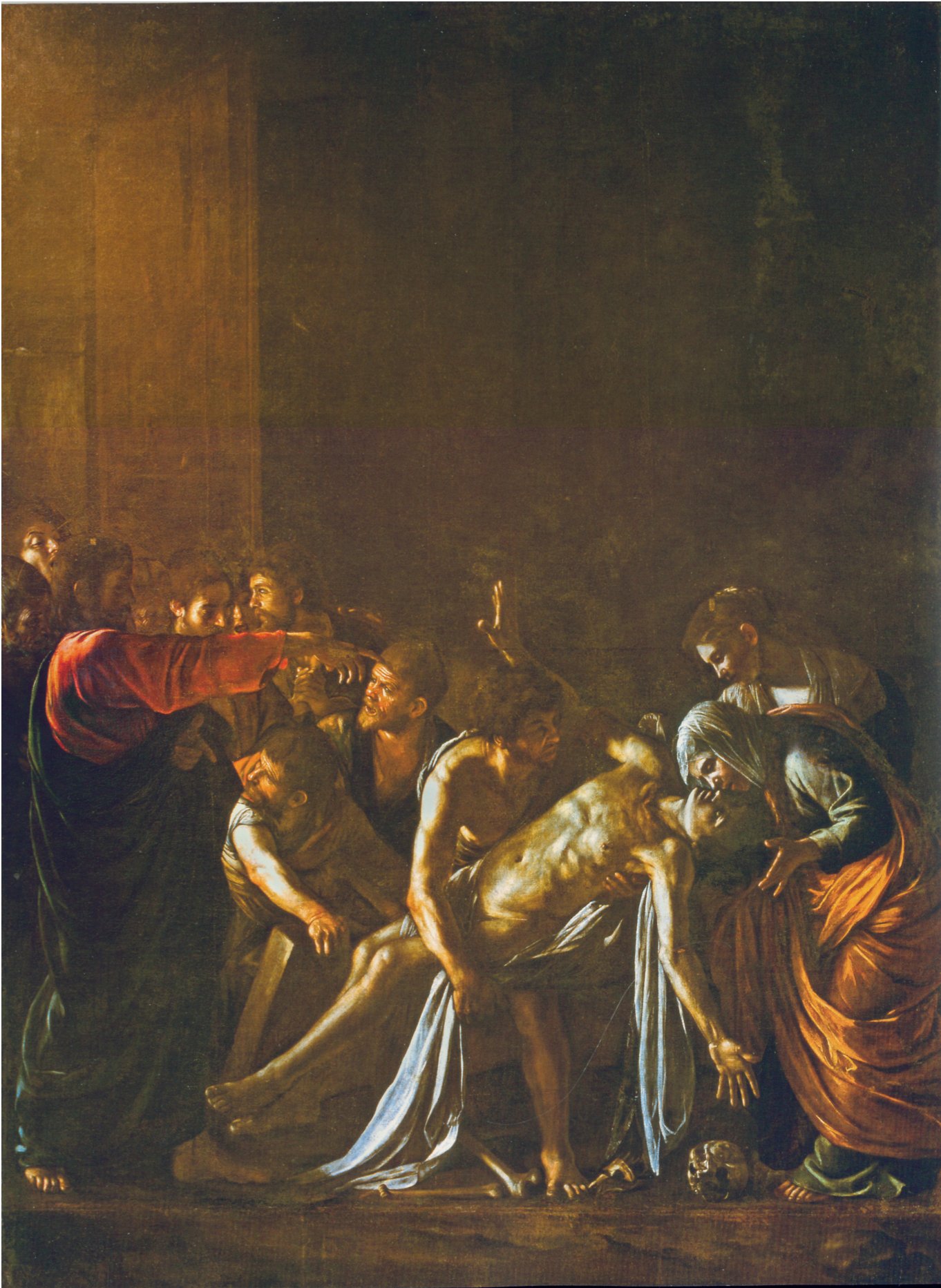
In his painting, Raising of Lazarus (Figure 8), Caravaggio elegantly and appropriately displays Christ calling Lazarus from his grave. This painting marks a pivotal point for Caravaggio. For the first time since the Martyrdom of Saint Matthew, the artist shows himself engaging in the action of the composition and paying attention to what is going on. Not only is Caravaggio engaged in the action but a spectator seems to notice him as well. Could this be the light to which Caravaggio looked in the other paintings, the miracle of life from death? Could it be that something has occurred causing the artist to recognize spirituality and therefore think differently about his religious subject matter? Perhaps, but because this is one instance where the painting does not communicate any psychopathic traits it is difficult to determine.
David with the Head of Goliath
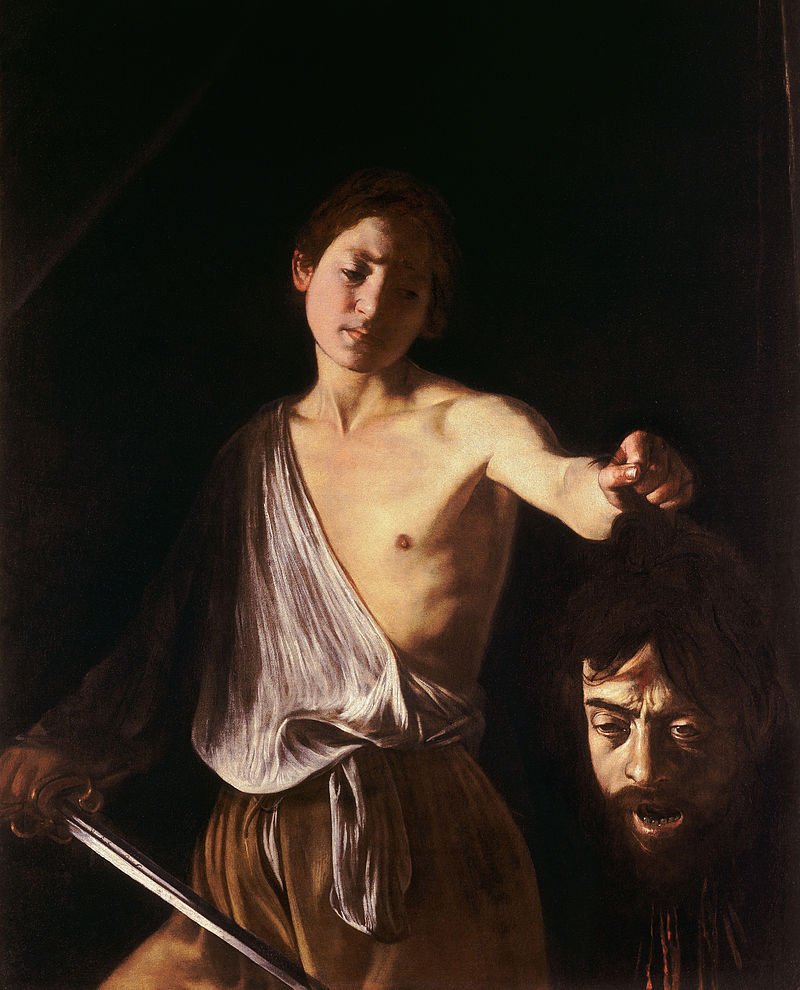
It would seem that at this time in Caravaggio’s life he has realized his errors. In the painting David with the Head of Goliath (Figure 9) there is a possible double self-portrait. If this is true, the artist is not only aware of his mental state; he is also repentant for his actions. According to the story of David and Goliath, the young man kills the proud giant by hitting him in the head with a stone and then using Goliath’s own sword to cut off his head. This display of recognition does not at all state that Caravaggio is not a psychopath because he feels guilt. Instead it displays the exact opposite. In “Self-reports of Faulty Parental Attachments in Childhood and Criminal Psychopathy in an Adult-Incarcerated Population: An Interrogative Literature Review,” C. Bailey and D. Shelton provide evidence suggesting that this could be the most direct and most important piece of evidence because the statement could hint at the problems beginning in adolescence, the time when factors such as abuse can determine if a person becomes a psychopath.
Martyrdom of Saint Ursula
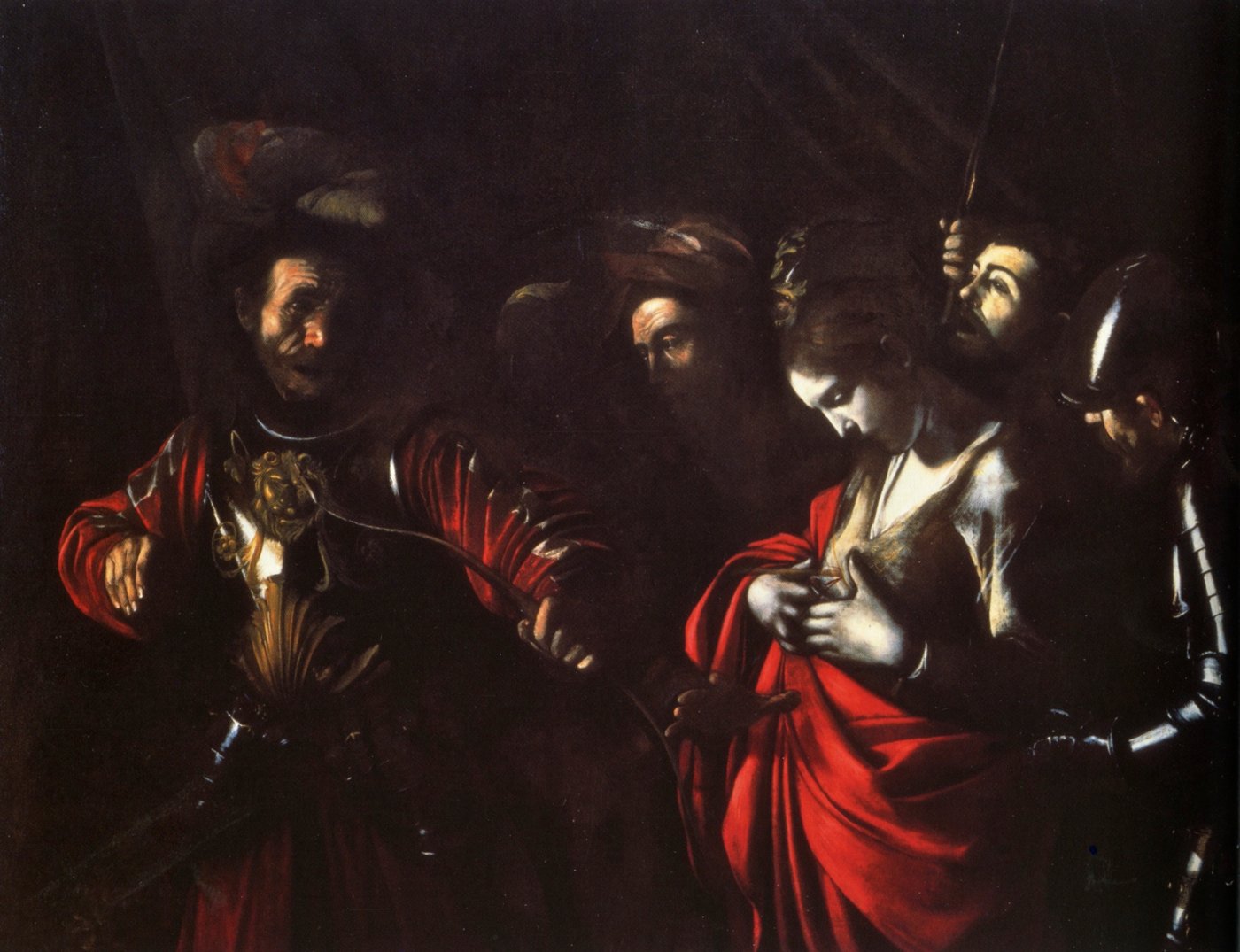
Caravaggio’s last self-portrait, David with the Head of Goliath, leads to implications that he is recovering from his mental illness, giving a moment of hope that he somehow reverted from his former tendencies. In the Martyrdom of Saint Ursula (Figure 10), Caravaggio is seen once again, placing himself in an image of a saint being killed while he is fixated on the light in the distance much like he is in Taking of Christ. This supports the idea that psychopathy, when unchecked, is consistent.
General Imagery
There are several related features within each painting presented. They are all focused on death. This is something that the artist would have been exposed to early on being that the plague took many lives around him. They are all religious works. Catholicism surrounded Caravaggio and it was sure to have greatly impacted the way he thought. Then there is the mysterious light present in all paintings. The light into which Caravaggio is seen staring, the same light that illuminates his face making him stand out in a crowded composition, is ominous and possibly holds the truth just beyond what the artist shows the viewer. Most importantly are the faces of every person in every painting. The faces of the saints, persecutors, and even Caravaggio are neutral, angry, or filled with fear. According to Ragbeer and Burnette, in “Remember Me? Psychopathic Traits and Emotional Memory in an Undergraduate Sample,” male psychopaths have little response to faces that express any other emotion except neutrality, fear, or anger. There is one exception found in the face of David in David with the Head of Goliath where evidence points to a break in Caravaggio’s view of his self. This piece once again shows up as introspective sadness.
Conclusion
Records of Caravaggio’s behavior do lead to the conclusion that he was indeed a psychopath. His constant disregard of the consequences for his actions and the nature of the crimes he committed are testaments to his character. Self-portraiture for artists is an opportunity to express themselves. As noticed by Philip Sohm in “Caravaggio’s Deaths,” there have been others who inserted themselves into their works, but Caravaggio created a noticeable pattern when he displayed his artwork, which is why his purposes for self-portraiture are put into question. The data gathered in the research has also given Caravaggio scores on Hare’s PCL-R that provide confidence in the argument that Caravaggio was a psychopath.
| Behavior | Trait | Points |
|---|---|---|
| Violence: Street brawls in adolescent and adult ages Sword fighting Rock throwing Assault with object Carrying weapons without permit One known murder victim | Need for Stimulation Lack of Remorse or Guilt Poor Behavioral Control Early Behavior Problems Impulsivity Juvenile Delinquency Revocation of Conditional Release Criminal Versatility | 14 |
| Lifestyle: Skilled painter Suggested studying of ancient art and culture Detailed knowledge of religious texts Homelessness Borrows money without repayment Constantly moving from one patron’s home to another Escaped Jail Fugitive, sentenced to death | Lying Parasitic Lifestyle Lack of Realistic Goals Irresponsible Short Relationships Revocation of Conditional Release Criminal Versatility | 8 |
| Morality: Several Arrests Many violent encounters Took part in liturgical devotion Joined Knights of Malta only to commit more crimes Uses status to account for crimes committed | Superficial Charm Grandiose Sense of Self Cunning/Manipulative Lack of Remorse or Guilt Poor Behavioral Control Early Behavioral Problems Fail to accept responsibility Revocation of Conditional Release Criminal Versatility | 8 |
| Mental and Emotion: Self portraits display neutral, angry, and sad faces Self portraits displayed in images with violent acts toward saints and their deaths Shows no remorse for crimes Shows little respect toward authorities Evades problems instead of facing consequences | Lack of Remorse or Guilt Lack of Empathy Fail to Accept Responsibility Revocation of Conditional Release | 2 |
| Total | 32 |
| Year | Behaviors | Paintings |
|---|---|---|
| 1584-1591 | Known to have been involved in street/sword fights | |
| 1597 | Questioned for his part in a brawl | |
| 1598 | Arrests made for carrying weapons without a license | |
| 1599 | Martyrdom of Saint Matthew | |
| 1600 | Involved in a fight | |
| 1602 | Taking of Christ | |
| 1605 | Homeless in Rome Accused of Throwing Stones in Colona | |
| 1606 | Wounded in the neck from possible fight, says he fell down stairs to avoid trouble Murder of Tomassoni Masetti wants money Caravaggio barrowed | |
| 1607 | Appears in Malta with Knights of Malta | |
| 1608 | Received into Order of the Knights of Malta Relations to crime with gun involved Imprisoned Escapes Prison | Beheading of Saint John Burial of Saint Lucy |
| 1609 | Injured badly from violent encounter | |
| 1610 | Death | David with Head of Goliath Martyrdom of Saint Ursula |
Sources
- 1Geoff Hamilton, “Mythos and Mental Illness: Psychopathy, Fantasy, and Contemporary Moral Life,” Journal of Medical Humanities 29, no. 4 (2008): 232
- 2Beatriz Péreza , Juan Herreroa , Judith Velascob, and Francisco Javier Rodriguez-Díaza, “A Contrastive Analysis of the Factorial Structure of the PCL-R: Which Model Fits Best the Data?”, The European Journal of Psychology Applied to Legal Context 7, no.1 (2015): 24
- 3Graham Gooch and Michael Williams, Hare Psychopathy Checklist—Revised PCL-R (New York: Oxford University Press, 2015),
- 4Hamilton, “Mythos and Mental Illness,” 232
- 5Helen Langdon, Caravaggio: A Life. London: Chatto and Windus, 1999 and Sybille Ebert-Schifferer, Caravaggio, trans. J. Paul Getty Treat (Los Angeles: J. Paul Getty Treat, 2009).
- 6Andrew Butterfield, “Brushes with Death,” News Republic 222, no. 3 (2000): 26-29
- 7Mark R. Dadds, David J. Hawes, Aaron D.J. Frost, Shane Vassallo, Paul Bunn, Kirsten Hunter, and Sabine Merz. “Learning to ‘talk the talk: the relationship of psychopathic traits to deficits in empathy across childhood.” Journal of Child Psychology and Psychiatry and Allied Disciplines 50, no. 5 (2009): 599-606, accessed November 10, 2016
- 8Langdon, “Caravaggio: A Life,”
- 9Langdon, “Caravaggio: A Life,”
- 10Matthew 6:3
- 11Matthew 14
- 12David M. Stone, “Signature Killer Caravaggio and the Poetics of Blood,” Art Bulletin 94, no. 4 (2012): 572-579
- 13Golden Legend Volume 2 page 59
- 14John 11
- 151 Samuel 17
- 16C. Bailey and D. Shelton, “Self-reports of Faulty Parental Attachments in Childhood and Criminal Psychopathy in an Adult-Incarcerated Population: An Interrogative Literature Review,” Student College of Education and Human Services 21, no.4 (2014): 370
- 17Sn. Ragbeer and Burnette, MI. “Remember me? Psychopathic traits and emotional memory in an undergraduate sample.” Personality and Individual Differences 54, no. 3 (2013): 372-377 accessed November 10, 2016.
- 18Philip Sohm, “Caravaggio’s Deaths,” Art Bulletin 84, no. 3 (2002): 459
Rate this piece.